|
VISITORS to Nantwich are being encouraged to
become clock watchers.
Or, at least, to tour the town by following brass clock plaques set in
pavements around town. Like the two above.
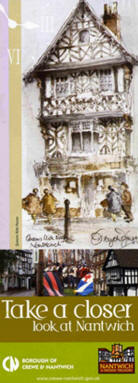
It is all to do with a new
version of the town guide, "Take a Closer look at Nantwich", just
published by Crewe and Nantwich Borough Council and the Town Centre
Management people, with support and assistance from Nantwich Civic Society.
It can be obtained through the Tourist
Information Centre at the Civic Hall in Market Street (tel 01270 610983), Crewe and Nantwich
Borough Council venues and "many town outlets".
After giving some of the history
of the town, the A4 fly (folded) booklet takes the visitor to The Square,
where there is the 1 o'clock plaque set in the pavement near to Nantwich
Bookshop at 46 High Street. The Queen's Aid House (they spell it "Aide")
and
Castle Street - leading to the supposed site of the town's wooden castle -
are also in the area.
After detailing more history, the
booklet moves on to the Museum in Pillory Street near to which is the 2
o'clock plaque. And so on . . .
Not that the visitor is expected
to take a full hour to absorb everything and then walk the couple of
hundred yards to the museum. Although some people I know take a lot of
time over such things, even they couldn't fill an hour on such a trek.
No, it is all symbolic. The full
walk is estimated to be three miles long and take one-and-a-half to two
hours to complete. If that is too much, a shorter (unspecified time and distance)
walk is suggested. A useful map is included in the booklet, which takes
visitors to 15 locations in the town - 1 o'clock to 12 o'clock with some
half hours - from The Square - as I said - up to the Shropshire Union Canal
and the aqueduct at the top of Welsh Row (10 o'clock).
The route then comes back to
Church Lane - and the former Lamb Hotel - and the parish church.
Of course, some visitors may have
to take in Mill
|
|
Island (10.30pm), Mill Street (11 o'clock) and
Chatterton House (12 o'clock) out of sequence, because the canal - by which they came
to Nantwich - will be the end of their
tour.
I know of two couples who came to live in Nantwich because they fell
in love with the town while "dropping in" during a holiday on the inland
waterways system.
An introduction to the booklet
says the walk has been provided as a "taster for the lovely town of
Nantwich and all she (sic) offers." I thought only ships were "ladies".
But it certainly will be a good
way of finding out about the town. Much better than a billed "walk around
the town" a friend and I had on a foreign holiday many years ago.
Expecting a tour with historical information, we
|
|
were surprised to find it was literally a walk
round the town - up in the hills above, from which we could look down as
we circumnavigated it!
The standard of the fixing-in of
the plaques varies
and some look a little stark (see the left-hand picture
above). Perhaps they will weather
in shortly.
And I presume tests have been
made on the polished surface. We don't want visitors - nor locals either,
for that matter - going home with a souvenir of a broken leg.
The booklet also contains many
advertisements to point the visitor to the local shops, as well as some
useful information. But for me, the highlights of the booklet are the colour
pen-and-ink sketches of Nantwich by the artist J. Haydn Jones who sadly
died in 1997. His work appears in many a Nantwich home. That's the
Queen's Aid(e) house in The Square on the front cover, above. Others are
black and white drawings.
The pictures are used with
the permission of A. B. & H. Prints who sell Haydn's work on behalf of the
J. Haydn Jones Estate.
UPDATE: Quoted in the Nantwich Guardian
of June 29, Elaine Dodd, the town centre manager, said: "It is our
intention that the guide remains flexible and the clock faces can be
easily added to in the future by using various minutes around the clock."
|
|
 Included
in the brochure is the "Nantwich - A
Hidden Treasure" logo (left) from Nantwich Forum
- something that I have always had mixed feelings about. Included
in the brochure is the "Nantwich - A
Hidden Treasure" logo (left) from Nantwich Forum
- something that I have always had mixed feelings about.
All right, maybe the town wasn't
as well known in the past as it is today (although I am sure it has been
known to many people throughout the country for centuries). From that
point of view, the "hidden" tag has some meaning.
But I can't help feeling that it
has the opposite meaning to what is intended. It's a bit like saying:
"We're here. But don't tell anyone." In fact, we want everyone to shout
it from the rooftops that Nantwich is here, and a town well worth visiting. That is
what I try do, any way! |


